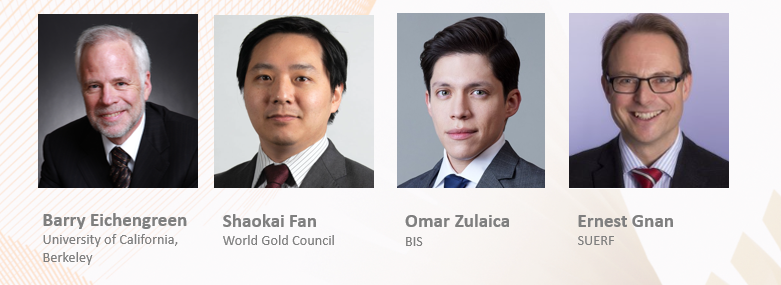
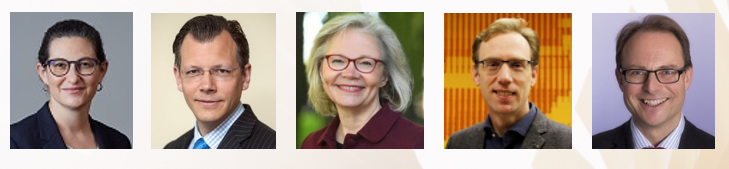
Dear colleagues, you and colleagues may be interested in these SUERF webinars: * SUERF BAFFI Bocconi e-lecture: Gold as International Reserves: A Barbarous Relic No More?<https://www.suerf.org/goldreserves> Thursday, 16 March 2023, 17:00-18:00 CET (online via Webex). Register here<https://www.suerf.org/registration/10651/goldreserves>. * SUERF BAFFI Bocconi e-lecture: Why are central banks reporting losses? Does it matter?<https://www.suerf.org/centralbanks> Tuesday, 21 March 2023, 15:00-16:15 CET (online via Webex). Register here<https://www.suerf.org/registration/10725/centralbanks>. Please feel free to forward this invitation within your institution and to your network. Kind regards Ernest Gnan _____________________________________________ Prof Dr Ernest Gnan Secretary General, SUERF – The European Money and Finance Forum Honorary Economic Advisor to the OeNB Governor ernest.gnan@oenb.at<mailto:ernest.gnan@oenb.at> +43 664 4333384 • @dr_gnan<https://twitter.com/dr_gnan> • LinkedIn<https://www.linkedin.com/in/ernest-gnan-8a6957ab/> www.suerf.org<http://www.suerf.org/> [SUERF.ORG]<http://www.suerf.org/?cid=17b13938bfa64d1d78f24bb559bf90d2&nid=76f47ae8e18db0a75586c8c34819665d&eid=ea1e375cac33fa78be527aba2b5237b3&uid=32dd05e463ae7c5e87a2b75a24f5c753&tid=6509a1f495f4463f1f951cd1658db0a9&pid=df494ebfc665abbe302b3dd78d1d9d3c> Invitation www.suerf.org<http://www.suerf.org> SUERF BAFFI Bocconi e-lecture “Gold as International Reserves: A Barbarous Relic No More?”<https://www.suerf.org/goldreserves> Thursday, 16 March 2023 | 17:00-18:00 CET | online via Webex| Register here<https://www.suerf.org/registration/10651/goldreserves> After moving slowly downward for the better part of four decades, central bank gold holdings have risen since the Global Financial Crisis. Which countries have been driving this trend reversal? What are the motifs of official gold reserve buyers? Relative return and/or safe haven considerations? Fear of sanctions? A group of top international experts presents empirical research findings on these questions and will discuss what might be in the pipeline with regards to the role of gold in official reserves. www.suerf.org/goldreserves<http://www.suerf.org/goldreserves> Speakers [cid:image005.png@01D950E2.8275F5E0] SUERF BAFFI Bocconi e-lecture “Why are central banks reporting losses: Does it matter?”<https://www.suerf.org/centralbanks> Tuesday, 21 March 2023 | 15:00-16:15 CET | online via Webex I Register here<https://www.suerf.org/registration/10725/centralbanks> Central banks have increasingly deployed their balance sheets in as a tool to pursue macroeconomic and financial stability objectives in support of their economies and to prevent inflation from falling far below target. After the Great Financial Crisis (GFC) and the European sovereign debt crisis as well as during the COVID pandemic, several advanced economy (AE) central banks used asset purchase programmes (APPs) or other lending programmes to achieve their policy aims. In doing so and to pursue their policy objectives, central banks took financial positions, which influence their profits and losses as a by-product. As policy rates are being hiked sharply to fight high inflation, several central banks incur sizeable losses as a result of their asset-liability composition. These losses may persist and even increase in coming years. Do such losses represent a threat to central banks’ financial independence and their credibility with regards to their anti-inflationary commitment? Why is insolvency (not) a concern for central banks? How could large and/or persistent losses be addressed in accounting terms? Will taxpayers’ money have to be injected, or will central banks just not transfer seigniorage income to governments for years to come? Ultimately, losses and negative equity do not directly affect the ability of central banks to operate effectively. In normal times and in crises, central banks should be judged exclusively on whether they fulfil their mandates. Central banks can underscore their continued ability to achieve policy objectives by clearly explaining the reasons for losses and highlighting the overall benefits of their policy measures. www.suerf.org/centralbanks<http://www.suerf.org/centralbanks> Speakers Sarah Bell, BIS; Ulrich Bindseil, ECB I SUERF Fellow; Patricia C Mosser, Columbia SIPA I SUERF Fellow; Peter Wierts, De Nederlandsche Bank, moderated by Ernest Gnan, SUERF [cid:image007.png@01D950E2.8275F5E0] Feel free to share this invitation with colleagues who might be interested to attend! We look forward to your participation! Save the date! ________________________________ * SUERF I Banco de España I Bank of Finland I Bank of Italy I ECB online workshop “Measuring economic slack or shortages: new methods and ways forward”<https://www.suerf.org/EconomicSlack> Monday, 27 March 2023 | 14:00-17:30 CET | online via Webex Scientific coordination Matthieu Darracq-Paries, ECB; Ernest Gnan, SUERF; Juha Kilponen, Bank of Finland; Alessandro Notarpietro, Banca d’ Italia, and Eva Ortega, Banco de España SUERF - The European Money and Finance Forum c/o OeNB, Otto-Wagner-Platz 3, A-1090 Vienna<https://maps.google.com/?q=Otto-Wagner-Platz+3,+A-1090+Vienna&entry=gmail&source=g> Tel: +43 1 40420 7216<tel:+431404207216> - E-mail: suerf@oenb.at<mailto:suerf@oenb.at>. Follow us [Suerf On Twitter] <https://twitter.com/suerf_org> [Suerf On LinkedIn] <https://www.linkedin.com/company/suerf---the-european-money-&-finance-forum> . Privacy Policy<https://www.suerf.org/privacy-policy> I Terms and Conditions<https://www.suerf.org/legal-notice> Diese E-Mail kann vertrauliche Informationen enthalten und irrtümlich an Sie gelangt sein. In diesem Fall informieren Sie bitte sofort die Absenderin bzw. den Absender und vernichten Sie diese E-Mail. Das unerlaubte Kopieren sowie die unbefugte Weitergabe dieser Mail oder von Teilen dieser Mail sind nicht gestattet. Informationen gemäß DSGVO zur Verarbeitung personenbezogener Daten durch die OeNB finden Sie unter www.oenb.at/datenschutz<https://www.oenb.at/datenschutz>.